Showing posts with label Of Mice and Men. Show all posts

Thursday, February 21, 2013

Naturalism as a Mirror of the 1930s

  
www.olystudio.com
 Literature is often a reflection of the time period in which it was written or, in the case of historical fiction, of the time period it is focused on.  Authors will often find sneaky little ways to demonstrate the dominant characteristics of the time period by blending in details, that, at a closer glance, reveal these hidden themes.

     In class, we viewed several videos (in the LitByFleming blog video bar) that gave us a look at some major events and common themes or characteristics of the 1930s.  John Steinbeck certainly considered these elements when writing Of Mice and Men.  In fact, it might be said, his writing style intentionally made use of naturalism in order to capture and expose some of the attitudes and characteristics of the American 1930s.
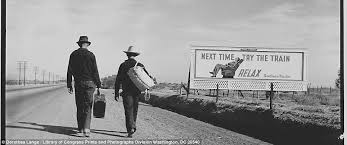
www.dailymail.co.uk
     Let's see if you can make the connection!  Think about some of  the naturalistic elements we identified in class (Chapter 1).  What aspects or characteristics of the 1930s are being demonstrated to us at those moments in the text?  What do you believe John Steinbeck was trying to show us or expose about the way people, life, or society was during this time in American history? 

Monday, February 18, 2013

Chapter Note-taking Criteria

Each blog post should demonstrate at least 3 out  of the following 5 areas of critical thinking:


1) Question:  Write down the names of characters involved, as well as where and when the story is taking place at this point in the text.  Next, write down questions you have about the story or characters, and any questions about the reading that you did not understand and would like clarification.

2) Prediction:  Write down your prediction for what you think will happen next in the story.  Don’t forget to explain what happened in this chapter that helped you form this prediction.

3) Connection:  Write down anything that you found familiar:  either a situation you have experienced, a character that reminds you of someone, or an event from the story that is similar to something you have already read.  *Remember to use good technology ethics!  Do not expose names of people anyone could or would know.  Use good judgement!

4) Summarize:  Re-tell, in your own words, the main plot and important details of your reading.  Your summary should not be more than about a paragraph, or 5-7 sentences.

5) Reflect:  Write down any quotes, sayings, or moments that affect you in some way.  So far, what do you think is the reason the author wrote this book?  Are there any themes you recognize?  Do you like the book so far?  Why or why not?  What changes could be made so that you understand or connect with the story better?